
Everyone is Your Biographer
on being narrated before you speak -- and what you can do about it.

Lisbon. Summer 2025. Some time after midnight.
I am waiting at this lounge bar.
Behind me, a group of women are talking in confidence- the kind of confidence you use when you are certain no one around you understands it. They’re speaking Mandarin.
They were talking about my locs. A bit about my skin tone.
Not kindly.
I turn around and ask them, in Mandarin, to repeat themselves.
The silence that follows is its own kind of answer.
They apologize. Aggressively, the way people do when they’re not sorry about the thought but are sorry it was heard. I nod. Turn back to the bar.
But I kept thinking about what had just happened—not the rudeness of it, which is ordinary enough, but the deeper mechanics of it. Those women had already written a complete chapter about me before I had said a single word. They looked at my locs, at my presence, at whatever version of me they could construct from a silhouette—and produced a narrative.
They were wrong about the Mandarin. They were not wrong about the fundamental act.
Everyone does it. All the time. About everyone.

We are all being narrated constantly—by the rooms we walk into, by the people who see us before we see them, by the digital trail we leave, by the details others carry forward from the last time they saw us. Every person who has ever encountered you is, in some sense, writing a version of you.
Most of these biographies are wrong in their details. All of them are real in their consequences.
Sociologist Charles Cooley called this the looking-glass self — the idea that our sense of who we are is shaped not by who we actually are, but by our perception of how others perceive us (Human Nature and the Social Order, 1902). We are, in part, the accumulated reflection of every biography others have written about us. The woman who assumed I didn’t speak Mandarin was not just making a social error. She was contributing to a looking-glass that, if I let it, could shape how I see myself in rooms like that one.
you are not just who you are. you are who every room thinks you are—until you correct the draft.
I. The Biography You Don’t Control
Before you walk into any room, someone has already written the first paragraph.
They have searched your name. Read your LinkedIn. Scrolled your Instagram. Asked a mutual contact what you’re like. Or they looked at you—your clothes, your posture, your hair, the way you hold the space around you—and constructed a working theory.
This is not malicious. It is human. We are pattern-recognition machines. We build models of people rapidly because it is cognitively efficient. The question is not whether people are writing your biography you speak. They are. The question is whether the biography they are constructing is the one you would choose.
The women in Lisbon had constructed a biography in which I was not fluent in Mandarin. That biography was so confident it licensed a conversation they would never have had in English or Portuguese.
Most of the biographies written about you aren’t that dramatic. But they are shaping which rooms you get invited into, which introductions get made on your behalf, which opportunities travel toward you and which ones travel away.

II. The Biography You Can Author
Goffman wrote in The Presentation of Self in Everyday Life (1959) that every social interaction is a performance—that we are always managing what we reveal and to whom. His insight was not that we are fake. It was that self-presentation is a real and serious act, and that the people who do it deliberately are not being manipulative. They are being precise.
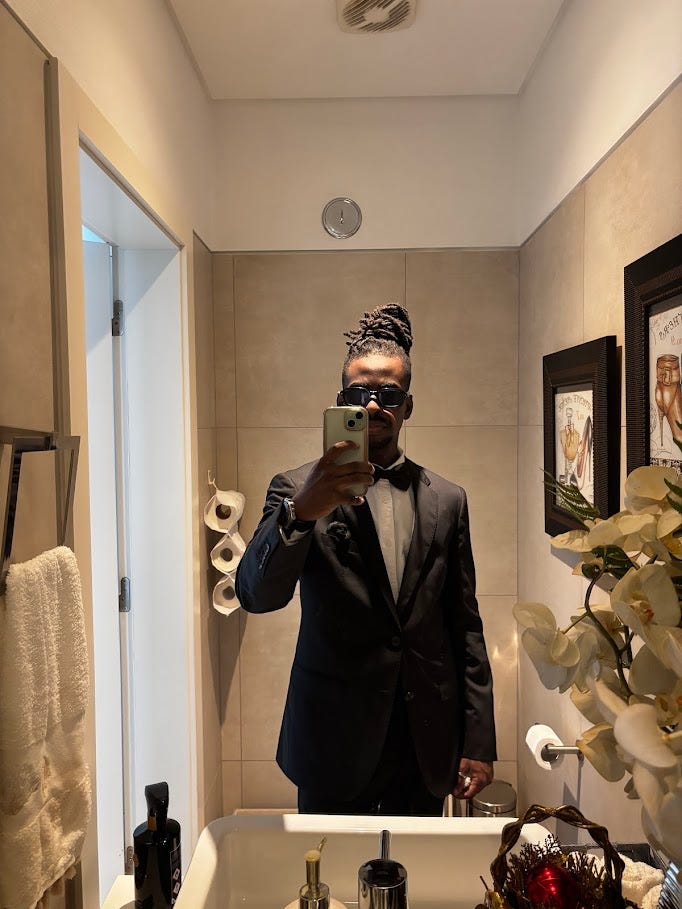
Your locs, your uniform, your silence, your language, your posture in a room—all of these are pages in a biography that other people are reading whether you wrote them or not. The difference between the person who is narrated by others and the person who narrates themselves is not authenticity. It is intention.
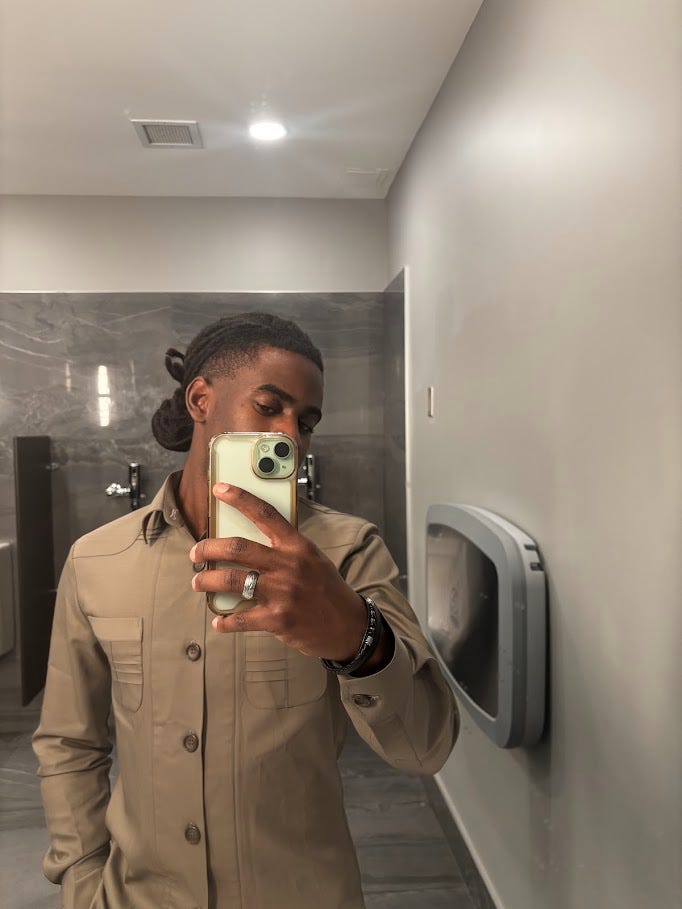
I deliberately wear the same four or five uniforms. Not because I lack imagination, but because consistency builds a legible identity across different rooms. The person who sees me in Chiado in a denim jacket and meets me again in a boardroom in an olive suit should feel like they are meeting the same person in different registers rather than two different people. The continuity is authored.
The locs are part of that too. They are not a statement. They are a detail in a biography I have chosen not to edit.
III. The Mandarin Principle
What happened at the bar was a correction.
Not a confrontation—I didn’t need to make them feel bad. I needed to update the biography. The chapter they had written was factually wrong, and I had the evidence to correct it in one sentence. Four words in Mandarin, and the whole narrative restructured itself in real time.
You will not always have the moment. Most of the biographies being written about you are written in a room you never enter, by people you will never meet. The correction has to happen upstream—in what you produce, in how you show up, in the trail you leave before the room even assembles.
Anthropologist Erving Goffman described this as impression management — the ongoing, active work of shaping what others perceive (Stigma, 1963). Not deception. Management,. The same way a city manages its skyline. Not by hiding what it is, but by deciding which structures are not most visible from a distance.
Your content is your skyline. Your tracked record is your architecture. Your presence in a room is the street-level experience. All three need to be telling the same story—or the biographies will fill in the gaps with whatever narrative is the most available.
The Verdict
I don’t think about the night in Lisbon with anger. I think about it as a clean demonstration of something I already knew but had never seen so precisely.
Everyone is your biographer. The people in line at the bar. The person who Googles you before the meeting. The contact who describes you to someone else using three words you will never hear. The room that watches you walk in and forms a theory before you have said anything.
You cannot stop the narration. You can only decide how much of it you authored.
Turn around. Ask them to repeat themselves.
Not always out loud. But always with intention.
Author the draft before someone else does it for you.